
Quiz, don't re-read
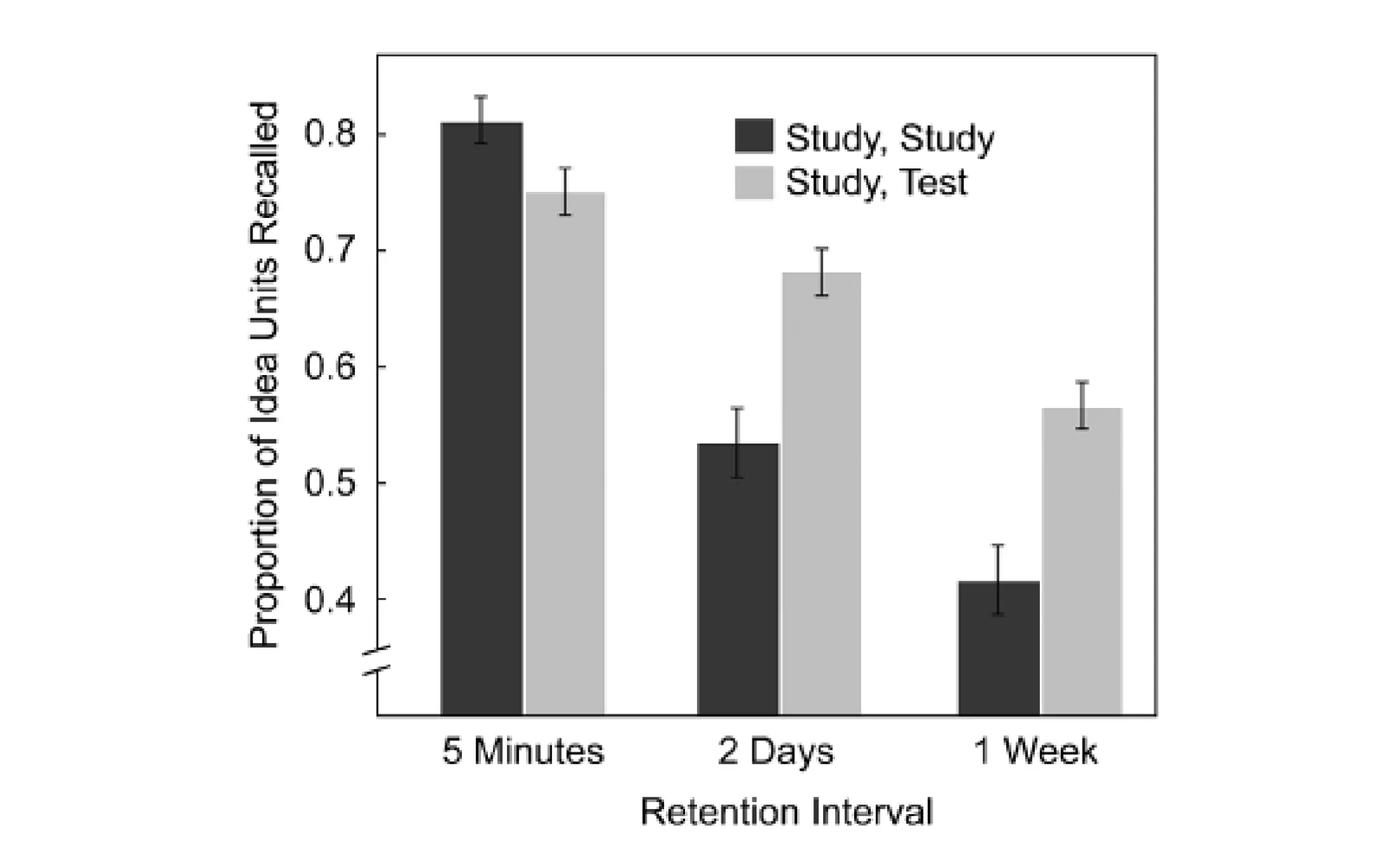
Trying to remember something makes it stick better than reading it again. In Roediger and Karpicke (2006), students who took a practice test recalled 56% of a passage a week later; students who re-read it recalled 42%. Reviews rate practice testing among the most useful study methods. DuckyHelper checks you with quick questions and quizzes, and turns what you miss into flashcards.
“Testing is a powerful means of improving learning, not just assessing it.”

Questions, quizzes and flashcards
In the film, Roediger and Karpicke's own chart grows, then a real quiz is answered. Every lesson keeps asking you to pull the idea back out:
- A check question after each step (Mac and web)
- Quizzes in the moment (Mac and web)
- Your turn on the blackboard (Mac and web)
- What you miss comes back (Mac and web)
What the research found
Henry Roediger and Jeffrey Karpicke had students read a short passage, then either read it again or take a recall test on it. Five minutes later, re-reading looked better. Two days and one week later, testing won clearly:
The tested group recalled 56% of the material, whereas the restudy group recalled only 42%
(Roediger & Karpicke, 2006)
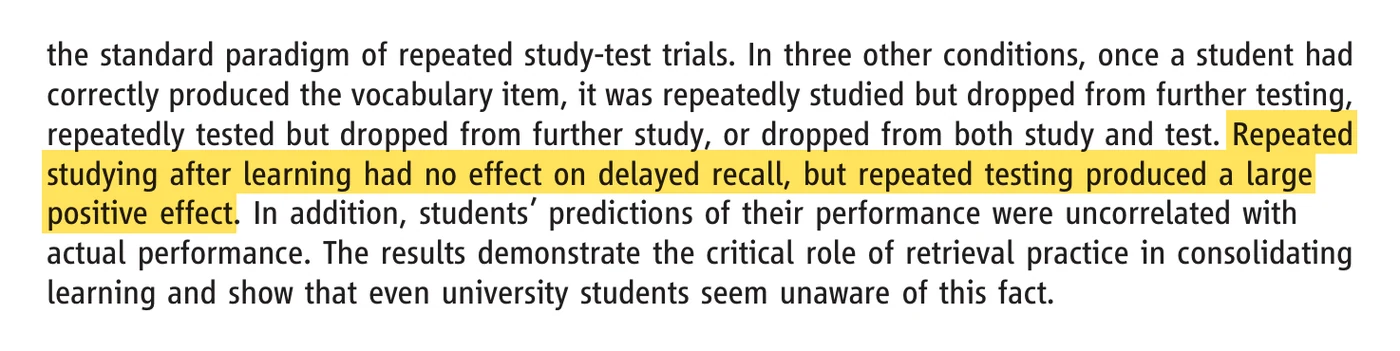
Later studies made it sharper. Once students could recall a word, more studying did nothing for a later test, while more testing helped a lot:
Repeated studying after learning had no effect on delayed recall, but repeated testing produced a large positive effect
(Karpicke & Roediger, 2008)
Retrieval even beat building concept maps, on a concept-mapping test (Karpicke and Blunt, 2011). A large review of ten study methods concluded:
Practice testing and distributed practice received high utility assessments
(Dunlosky et al., 2013)
One more finding matters for any tutor: students who re-read often feel surer than they should (Karpicke and Roediger, 2008, found students' predictions were uncorrelated with how they actually did). A quick question is the honest check.
Feature by feature

A check question after each step
After each step it asks you a quick question and waits for your answer. After it explains a page, it asks one question about what the page says. Every lesson ends with a short recap and one more question. Mac and web.
Quizzes in the moment
Say "quiz me on ...": multiple choice, true or false, typed math, fill in the blanks, put steps in order, match pairs or label a drawing, with "Not quite" and why when you miss, and a score at the end. In Eddy a quiz docks beside the picture as a Quick check. Mac and web.
Your turn on the blackboard
Eddy's blackboard explanations end by handing you a "your turn". Mac and web.
What you miss comes back
Missed quiz questions become flashcards by themselves, so you get to retrieve them again later. Mac and web.
What this page does not claim
These studies tested other people, other schools and other tools. DuckyHelper has not been tested in a study like these, so none of these results are DuckyHelper's results. They are the reasons behind how it teaches.
The papers on this page
Frequently asked questions
What is retrieval practice?
Practicing pulling information out of memory, for example with a quiz or a blank page, instead of reading it again. It is also called the testing effect, because taking a test is itself a way to learn.
Is re-reading notes a good way to study?
It feels good but works less well. In Roediger and Karpicke (2006), re-reading won at five minutes but lost at two days and one week, when the tested group recalled 56% against 42%.
How does DuckyHelper quiz me?
Ask "quiz me on" a topic and a short quiz opens while you keep talking. The tutor also asks quick check questions as it teaches, and your missed questions come back later as flashcards.
Sources
- Roediger, H. L., & Karpicke, J. D. (2006). Test-Enhanced Learning: Taking Memory Tests Improves Long-Term Retention. Psychological Science, 17(3), 249-255. (accessed 2026-10-09)
- Karpicke, J. D., & Roediger, H. L. (2008). The Critical Importance of Retrieval for Learning. Science, 319(5865), 966-968. (accessed 2026-10-09)
- Karpicke, J. D., & Blunt, J. R. (2011). Retrieval Practice Produces More Learning than Elaborative Studying with Concept Mapping. Science, 331(6018), 772-775. (accessed 2026-10-09)
- Dunlosky, J., Rawson, K. A., Marsh, E. J., Nathan, M. J., & Willingham, D. T. (2013). Improving Students’ Learning With Effective Learning Techniques: Promising Directions From Cognitive and Educational Psychology. Psychological Science in the Public Interest, 14(1), 4-58. (accessed 2026-10-09)
- Bangert-Drowns, R. L., Kulik, C.-L. C., Kulik, J. A., & Morgan, M. (1991). The Instructional Effect of Feedback in Test-like Events. Review of Educational Research, 61(2), 213. (accessed 2026-10-09)
- Rosenshine, B. (2012). Principles of Instruction: Research-Based Strategies That All Teachers Should Know. American Educator. (accessed 2026-10-09)
Related principles

Ready to learn
DuckyHelper is ready on your Mac. Learn with Eddy on its blackboard, or with Ducky right on your screen.