
Explain it back in your own words
Students who explain what they read or study to themselves, in their own words, understand it better. Chi and colleagues found good students generate many such explanations, and that simply prompting eighth graders to self-explain a text improved their learning. DuckyHelper asks what you think before it explains and checks your understanding with a question after each step.
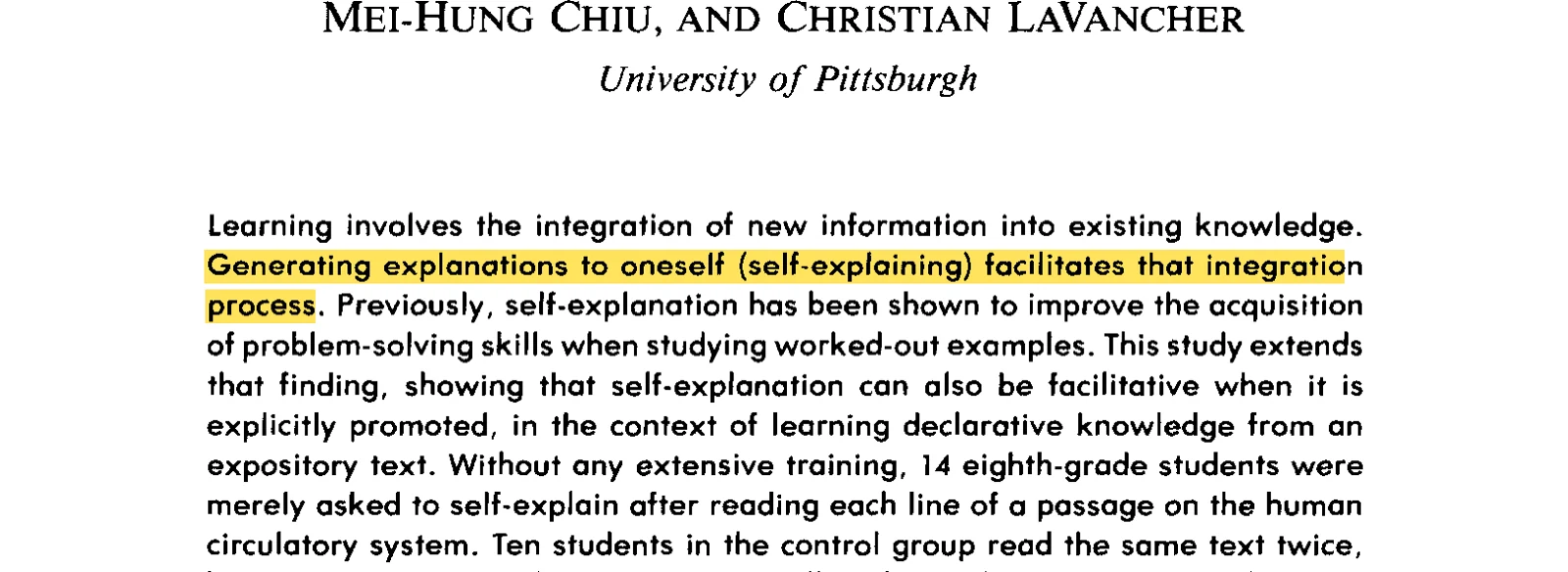
“Generating explanations to oneself (self‐explaining) facilitates that integration process”

It asks for your words
In the film, the learner's own sentence fills the screen over Chi and colleagues' page. In the app, the tutor keeps handing the explaining back to you:
- It asks what you think first (Mac and web)
- A check question after each step (Mac and web)
- Think out loud, it writes it down (Mac app)
- Your turn (Mac and web)
What the research found
Michelene Chi and colleagues listened to students thinking out loud while they studied worked physics examples. The difference between strong and weak students was what they said to themselves:
“Good” students learn with understanding: They generate many explanations
(Chi et al., 1989)
Then they tested it. Eighth graders read a text about the human circulatory system; one group was asked to explain each line to themselves, the other read it twice.
The prompted group had a greater gain from the pretest to the posttest.
(Chi et al., 1994a)
The authors' explanation is the line quoted at the top of this page: explaining to yourself is how new information gets joined to what you already know.
Chi and Wylie's ICAP framework puts it in one line: learning rises as students move from listening, to doing, to producing their own ideas, to building ideas together with someone.
from passive to active to constructive to interactive, their learning will increase
(Chi & Wylie, 2014)
Explaining also exposes what we do not know. People think they understand how everyday things work far better than they do, until they try to explain them (Rozenblit and Keil, 2002).
Feature by feature

It asks what you think first
It starts by asking what you think. Then it gives a hint or a guiding question and lets you take the next step yourself. Mac and web.
A check question after each step
After each step of an explanation it asks one question and waits for your answer, so you put the idea in your own words before going on. Mac and web.
Think out loud, it writes it down
In the Mac app, talk through your own steps and Ducky writes each one on the shared whiteboard as you say it, checking the math as it goes. If a step goes wrong, it leaves a short note about where to look, not the fix, and you redo just that step. Mac app.
Your turn
Eddy's blackboard lessons end by handing the idea back to you with a "your turn". Mac and web.
Being honest about it
DuckyHelper does not yet have a separate "explain it back to me" mode. The behaviour above is what it does today.
What this page does not claim
These studies tested other people, other schools and other tools. DuckyHelper has not been tested in a study like these, so none of these results are DuckyHelper's results. They are the reasons behind how it teaches.
The papers on this page
Frequently asked questions
What is the self-explanation effect?
Students who explain material to themselves while studying, saying why each step works or how an idea connects to what they know, understand it better. Chi et al. (1989) found it in strong students; Chi et al. (1994) showed that prompting students to do it helps.
What is the ICAP framework?
A framework by Chi and Wylie (2014): Interactive, Constructive, Active and Passive engagement. Learning tends to increase as students move from passive to active to constructive to interactive.
How can I practice self-explanation with DuckyHelper?
Tell the tutor what you think before it explains, and answer its check questions in your own words. In the Mac app you can talk through your steps out loud and Ducky writes them on the whiteboard and checks them.
Sources
- Chi, M. T. H., Bassok, M., Lewis, M. W., Reimann, P., & Glaser, R. (1989). Self-Explanations: How Students Study and Use Examples in Learning to Solve Problems. Cognitive Science, 13(2), 145-182. (accessed 2026-10-09)
- Chi, M. T. H., De Leeuw, N., Chiu, M.-H., & Lavancher, C. (1994a). Eliciting Self-Explanations Improves Understanding. Cognitive Science, 18(3), 439-477. (accessed 2026-10-09)
- Chi, M. T. H., & Wylie, R. (2014). The ICAP Framework: Linking Cognitive Engagement to Active Learning Outcomes. Educational Psychologist, 49(4), 219-243. (accessed 2026-10-09)
- Roscoe, R. D., & Chi, M. T. H. (2007). Understanding Tutor Learning: Knowledge-Building and Knowledge-Telling in Peer Tutors’ Explanations and Questions. Review of Educational Research, 77(4), 534-574. (accessed 2026-10-09)
- Rozenblit, L., & Keil, F. (2002). The misunderstood limits of folk science: an illusion of explanatory depth. Cognitive Science, 26(5), 521-562. (accessed 2026-10-09)
- Legare, C. H., & Lombrozo, T. (2014). Selective effects of explanation on learning during early childhood. Journal of Experimental Child Psychology, 126, 198-212. (accessed 2026-10-09)
- Lombrozo, T. (2006). The structure and function of explanations. Trends in Cognitive Sciences, 10(10), 464-470. (accessed 2026-10-09)
- Dunlosky, J., Rawson, K. A., Marsh, E. J., Nathan, M. J., & Willingham, D. T. (2013). Improving Students’ Learning With Effective Learning Techniques: Promising Directions From Cognitive and Educational Psychology. Psychological Science in the Public Interest, 14(1), 4-58. (accessed 2026-10-09)
Related principles

Ready to learn
DuckyHelper is ready on your Mac. Learn with Eddy on its blackboard, or with Ducky right on your screen.