
Keep the learner doing, not watching
Students learn more when they do things in class instead of only listening. A review of 225 studies found exam scores rose and students in lecture-only classes were 1.5 times more likely to fail. Active learning can feel like learning less, even when it is learning more. DuckyHelper is built to keep you doing: predicting, answering, drawing and clicking through it yourself.
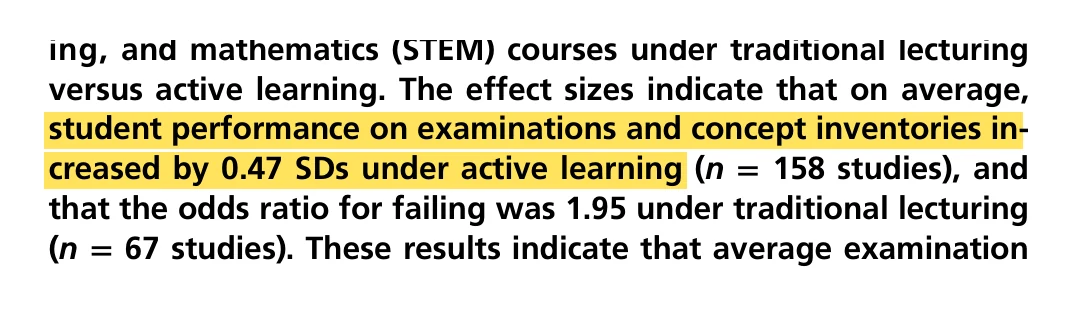
“student performance on examinations and concept inventories increased by 0.47 SDs under active learning”

You do it, it guides
In the film, a learner is asked whether a 1 second swing needs a longer or shorter string, then drags the length to find out. Lessons are built around things you do:
- Predict, then play (Mac and web)
- You do, it guides (Mac and web)
- Learn an app by using it (Mac app)
- Graphs you touch (Mac and web)
What the research found
Scott Freeman and colleagues pooled 225 studies of science, engineering and math courses. Exam and concept test scores rose under active learning, by 0.47 standard deviations on average (the line quoted at the top of this page), and students in traditional lecture classes were 1.5 times more likely to fail. A Harvard physics study then asked students how much they felt they learned. Students in active classes learned more but felt they learned less:
when students experience the increased cognitive effort associated with active learning, they initially take that effort to signify poorer learning
(Deslauriers et al., 2019)
Struggle can come first. In Manu Kapur's studies of productive failure, students who wrestled with hard problems before being taught did worse at first and better later:
suggesting a latent productivity in what initially seemed to be failure
(Kapur, 2008)
Schwartz and Bransford (1998) found that exploring contrasting cases first prepared students to learn more from a later explanation. The ICAP framework (Chi and Wylie, 2014) ranks the kinds of doing: constructing your own ideas, and building them with someone, beat merely being active.
Feature by feature

Predict, then play
Simulations you run yourself: drag the pendulum, move the sliders, read the numbers. The tutor asks you to guess what will happen first, then talks about the changes you make. Mac and web.
You do, it guides
Lessons go back and forth: short steps, a question after each one, and quizzes you answer on the spot. Mac and web.
Learn an app by using it
Tutorials happen in your own apps, with your own clicks and typing; Ducky moves on when you did the step. Mac app.
Graphs you touch
Hover, pan and zoom a graph, and drag the sliders for its letters to see what each one does. Mac and web.
What this page does not claim
These studies tested other people, other schools and other tools. DuckyHelper has not been tested in a study like these, so none of these results are DuckyHelper's results. They are the reasons behind how it teaches.
The papers on this page
Frequently asked questions
What is active learning?
Teaching where students do things, such as answering questions, solving problems, discussing and predicting, instead of only listening. Freeman et al. (2014) found it raised exam performance across 225 studies.
Why does active learning feel harder?
Deslauriers et al. (2019) found students in active classes learned more but felt they learned less, because they read the extra effort as a sign of poor learning. The effort is part of the learning.
How does DuckyHelper keep me active?
It asks you questions instead of lecturing, quizzes you in the moment, lets you run simulations and graphs yourself, and in the Mac app teaches apps by having you do each step.
Sources
- Freeman, S., Eddy, S. L., McDonough, M., Smith, M. K., Okoroafor, N., Jordt, H., & Wenderoth, M. P. (2014). Active learning increases student performance in science, engineering, and mathematics. Proceedings of the National Academy of Sciences, 111(23), 8410-8415. (accessed 2026-10-09)
- Deslauriers, L., McCarty, L. S., Miller, K., Callaghan, K., & Kestin, G. (2019). Measuring actual learning versus feeling of learning in response to being actively engaged in the classroom. Proceedings of the National Academy of Sciences, 116(39), 19251-19257. (accessed 2026-10-09)
- Kapur, M. (2008). Productive Failure. Cognition and Instruction, 26(3), 379-424. (accessed 2026-10-09)
- Schwartz, D. L., & Bransford, J. D. (1998). A Time For Telling. Cognition and Instruction, 16(4), 475-522. (accessed 2026-10-09)
- Chi, M. T. H., & Wylie, R. (2014). The ICAP Framework: Linking Cognitive Engagement to Active Learning Outcomes. Educational Psychologist, 49(4), 219-243. (accessed 2026-10-09)
- National Research Council; Bransford, J. D., Brown, A. L., & Cocking, R. R. (Eds.) (2000). How People Learn: Brain, Mind, Experience, and School: Expanded Edition. National Academies Press (book). (accessed 2026-10-09)
- Koedinger, K. R., Corbett, A. T., & Perfetti, C. (2012). The Knowledge-Learning-Instruction Framework: Bridging the Science-Practice Chasm to Enhance Robust Student Learning. Cognitive Science, 36(5), 757-798. (accessed 2026-10-09)
Related principles

Ready to learn
DuckyHelper is ready on your Mac. Learn with Eddy on its blackboard, or with Ducky right on your screen.