
Just enough help
Scaffolding is help that does the parts of a task a learner cannot do yet, so they can do the rest themselves, and that is taken away as they improve. The idea comes from Wood, Bruner and Ross (1976) and Vygotsky's zone of proximal development. DuckyHelper scaffolds with a ladder of hints, step-by-step tutorials that wait for you, and worked examples it fades.
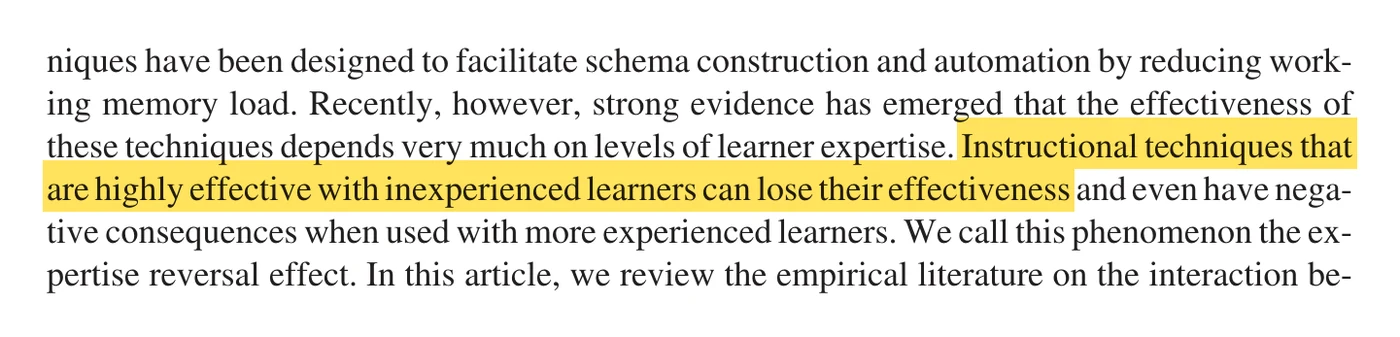
“Instructional techniques that are highly effective with inexperienced learners can lose their effectiveness”

Help that comes one rung at a time
In the film, three presses of Hint open a nudge, a bigger hint and a worked step, and the learner finishes the problem. The same idea runs through the app:
- A hint ladder you climb yourself (Mac app)
- Tutorials that wait for you (Mac app)
- Watch me, then you (Mac app)
- A similar example when you are stuck (Mac and web)
- Pitched at your level (Mac and web)
What the research found
The word comes from a 1976 study of a tutor helping young children build a puzzle. David Wood, Jerome Bruner and Gail Ross described the tutor taking care of the parts of the task the child could not yet manage, so the child could focus on, and finish, the parts within reach. They called this support scaffolding.
Lev Vygotsky's zone of proximal development describes where that help is useful: the gap between what a learner can do alone and what they can do with guidance. He defined it as
the distance between the actual developmental level as determined by independent problem solving
(Vygotsky, 1978)
and the level reached with an adult's guidance or a more capable peer. Teaching aims at that edge.
Help should fade
Strong guidance helps beginners. Kirschner, Sweller and Clark (2006) reviewed the evidence and wrote that
minimally guided instruction is less effective and less efficient than instructional approaches that place a strong emphasis on guidance
(Kirschner et al., 2006)
But the same help can get in the way later. This is the expertise reversal effect: techniques that work best for beginners can lose their effect as learners gain skill (Kalyuga et al., 2003).
Barak Rosenshine's summary of research for teachers puts it simply:
Present new material in small steps with student practice after each step
(Rosenshine, 2012)
Hints are one way to scaffold, and how they are given matters. Learners often use help badly, asking for it too soon or not at all (Aleven et al., 2003), and hints generated from past students' work helped students keep going in a logic course (Stamper et al., 2011).
Feature by feature

A hint ladder you climb yourself
Press Hint on a problem in the Mac app: a nudge first, then a bigger hint, then the worked step, and the answer last. You decide how much help you need, and the hints you use count against your mastery of that skill. Mac app.
Tutorials that wait for you
Ask how to do something in an app and Ducky walks you through it on your real screen. It watches your clicks and typing and moves on only when you really did the step. Mac app.
Watch me, then you
"Show me first": the pointer does the task once while Ducky narrates, then it says "your turn" and becomes a tutorial that checks you. Mac app.
A similar example when you are stuck
If you are really stuck after a real try, it works through a similar problem with you, then hands your own problem back to you. Mac and web.
Pitched at your level
It judges your level from how you talk and what is on your page, and explains at that level. Mac and web.
What this page does not claim
These studies tested other people, other schools and other tools. DuckyHelper has not been tested in a study like these, so none of these results are DuckyHelper's results. They are the reasons behind how it teaches.
The papers on this page
Frequently asked questions
What is scaffolding in education?
Scaffolding is temporary help that handles the parts of a task a learner cannot do yet, so they can complete the rest, and that is removed as they improve. The term comes from Wood, Bruner and Ross (1976).
What is the zone of proximal development?
Vygotsky's term for the gap between what a learner can do alone and what they can do with guidance from an adult or a more capable peer. Good teaching aims inside that gap.
Why does DuckyHelper give hints one at a time?
So you get just enough help to take the next step yourself. The Mac app's hint ladder opens one rung at a time, from a nudge to the worked step, and leaves the answer for last.
Sources
- Wood, D., Bruner, J. S., & Ross, G. (1976). The Role of Tutoring in Problem Solving. Journal of Child Psychology and Psychiatry, 17(2), 89-100. (accessed 2026-10-09)
- Vygotsky, L. S. (1978). Mind in Society: The Development of Higher Psychological Processes. Harvard University Press (book). (accessed 2026-10-09)
- Kirschner, P. A., Sweller, J., & Clark, R. E. (2006). Why Minimal Guidance During Instruction Does Not Work: An Analysis of the Failure of Constructivist, Discovery, Problem-Based, Experiential, and Inquiry-Based Teaching. Educational Psychologist, 41(2), 75-86. (accessed 2026-10-09)
- Kalyuga, S., Ayres, P., Chandler, P., & Sweller, J. (2003). The Expertise Reversal Effect. Educational Psychologist, 38(1), 23-31. (accessed 2026-10-09)
- Rosenshine, B. (2012). Principles of Instruction: Research-Based Strategies That All Teachers Should Know. American Educator. (accessed 2026-10-09)
- Aleven, V., Stahl, E., Schworm, S., Fischer, F., & Wallace, R. (2003). Help Seeking and Help Design in Interactive Learning Environments. Review of Educational Research, 73(3), 277-320. (accessed 2026-10-09)
- Stamper, J. C., Eagle, M., Barnes, T., & Croy, M. (2011). Experimental Evaluation of Automatic Hint Generation for a Logic Tutor. AIED. (accessed 2026-10-09)
- Razzaq, L., & Heffernan, N. T. (2006). Scaffolding vs. Hints in the Assistment System. ITS. (accessed 2026-10-09)
- Kapur, M. (2008). Productive Failure. Cognition and Instruction, 26(3), 379-424. (accessed 2026-10-09)
Related principles

Ready to learn
DuckyHelper is ready on your Mac. Learn with Eddy on its blackboard, or with Ducky right on your screen.