
Teach one on one
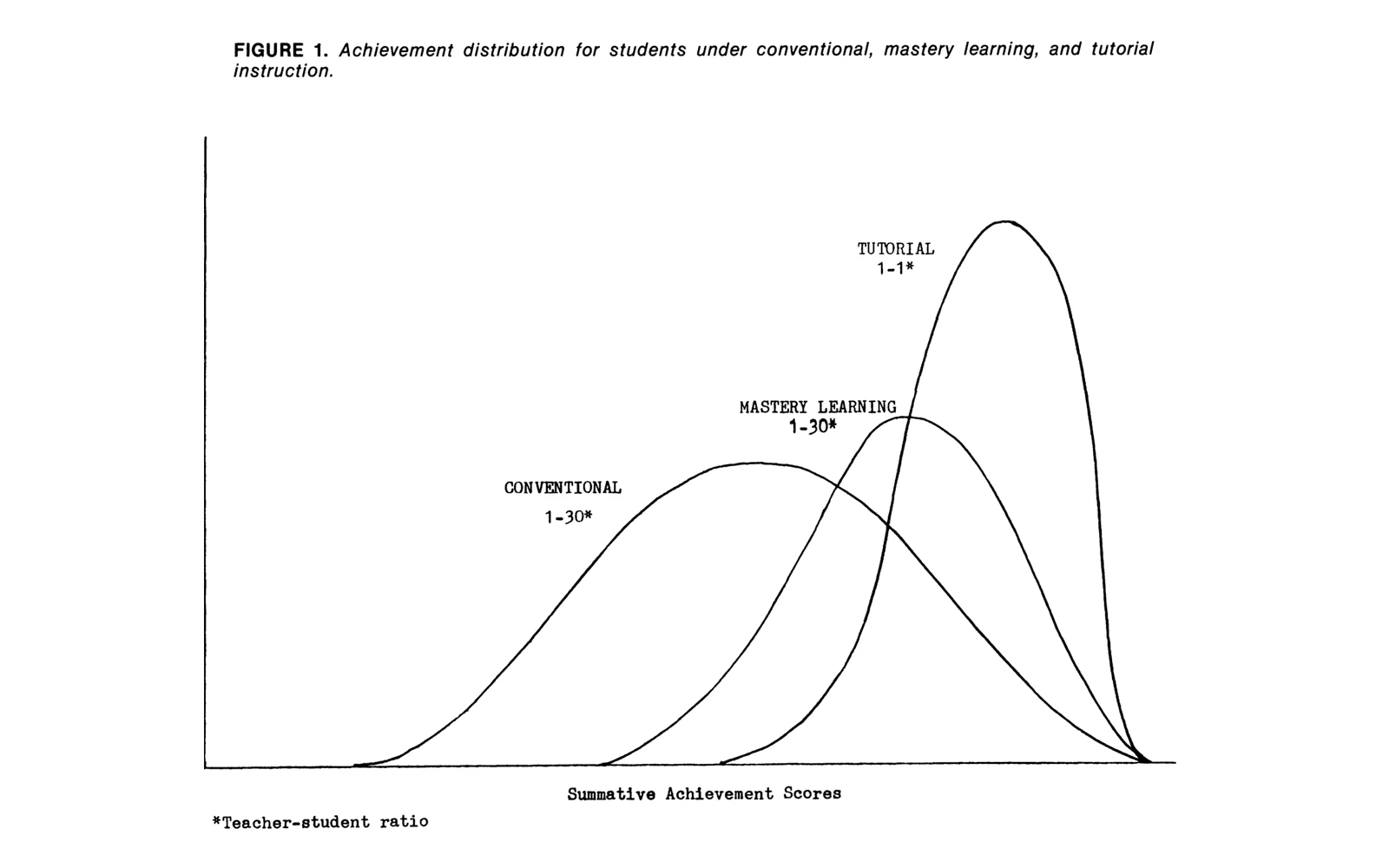
In 1984 Benjamin Bloom reported that students taught by a tutor, one on one, scored about two standard deviations above students taught in a regular class: the average tutored student did better than 98% of the class. He called finding a cheaper way to get that result the 2 sigma problem. DuckyHelper is a one-on-one tutor you talk to, built to teach the way good tutors do.
“the average student under tutoring was about two standard deviations above the average of the control class”

A tutor for one learner at a time
In the film, Bloom's own figure appears and the tutoring curve is ringed. In the app, that one-on-one conversation is the whole design:
- One learner, one tutor, out loud (Mac and web)
- It starts from what you think (Mac and web)
- It meets you at your level (Mac and web)
- It sees what you see (Mac app)
- It remembers you (Mac and web)
What the research found
Bloom's graduate students taught the same short unit three ways. In a conventional class of about 30 students per teacher, tests were given for marks. In a mastery learning class, also about 30 students, tests were used for feedback and corrections. With tutoring, each student had a good tutor (or one tutor for two or three students), plus the same tests and corrections.
In the paper's words, the average tutored student "was above 98% of the students in the control class". The catch was cost: Bloom described one-to-one tutoring as "too costly for most societies to bear on a large scale", and asked how group teaching could get close to it. That question is the 2 sigma problem.
How big is the effect, really?
Bloom's number came from a few small studies run by his own students. Later reviews of many studies found real but smaller effects. Kurt VanLehn's 2011 review measured human tutoring at an effect size of 0.79, and step-by-step computer tutors close behind:
the effect size of intelligent tutoring systems was 0.76, so they are nearly as effective as human tutoring
(VanLehn, 2011)
A 2024 meta-analysis of randomized tutoring programs for children found an overall pooled effect of 0.288 standard deviations, and concluded:
tutoring programs yield consistently substantial positive impacts on learning
(Nickow et al., 2024)
What good tutors do
Studies of real tutoring sessions point to the same few moves: tutors solve the problem with the student, ask questions, and react to mistakes right away. In one study, tutors were told to stop explaining and only prompt the student, and the students still learned:
students learned just as effectively even when tutors were suppressed from giving explanations and feedback
(Chi et al., 2001)
Naturalistic one‐to‐one tutoring is more effective than traditional classroom teaching methods
(Graesser et al., 1995)
Highly effective tutors also look after how the student feels, not only what they know (Lepper and Woolverton, 2002).
Feature by feature

One learner, one tutor, out loud
You talk, and the tutor answers out loud while it shows things: on your screen with Ducky, on Eddy's desk in the Eddy tab. It talks with one learner at a time, back and forth, instead of lecturing. Mac app.
It starts from what you think
Before a big topic it asks what you already know. Then it explains in short steps and checks in with you after each one, waiting for your answer before it moves on. Mac and web.
It meets you at your level
It keeps things simple and cheerful for young kids and gets to the point with adults, in whatever language you speak. It judges your level from how you talk and what is on your page. Mac and web.
It sees what you see
In the Mac app, Ducky looks at your screen while the pill is open, so it answers about the exact thing you mean, the way a tutor sitting next to you would. Mac app.
It remembers you
Memory keeps notes about how you learn between sessions, and Mistakes lists the slips it noticed so they can be practiced away. Mac and web.
What this page does not claim
These studies tested other people, other schools and other tools. DuckyHelper has not been tested in a study like these, so none of these results are DuckyHelper's results. They are the reasons behind how it teaches.
The papers on this page
The 2 Sigma Problem: The Search for Methods of Group Instruction as Effective as One-to-One Tutoring
Frequently asked questions
What is Bloom's 2 sigma problem?
In 1984 Benjamin Bloom reported that students taught one on one by a tutor scored about two standard deviations above students in a regular class. Because a tutor for every student is too costly, he challenged researchers to find group methods that work as well. That challenge is the 2 sigma problem.
Is the two standard deviation result still accepted?
The direction is, the size is debated. Bloom's number came from a few small studies. Later reviews found smaller but real effects, such as 0.79 for human tutoring in VanLehn (2011) and a pooled 0.288 for tutoring programs in Nickow, Oreopoulos and Quan (2024).
Does DuckyHelper claim to raise scores by two standard deviations?
No. DuckyHelper has not been tested in a study like Bloom's, so it makes no claim about effect sizes. It is built to teach the way the research says good tutors teach: one on one, with questions, steps and quick checks.
Sources
- Bloom, B. S. (1984). The 2 Sigma Problem: The Search for Methods of Group Instruction as Effective as One-to-One Tutoring. Educational Researcher, 13(6), 4-16. (accessed 2026-10-09)
- VanLehn, K. (2011). The Relative Effectiveness of Human Tutoring, Intelligent Tutoring Systems, and Other Tutoring Systems. Educational Psychologist, 46(4), 197-221. (accessed 2026-10-09)
- Nickow, A., Oreopoulos, P., & Quan, V. (2024). The Promise of Tutoring for PreK-12 Learning: A Systematic Review and Meta-Analysis of the Experimental Evidence. American Educational Research Journal, 61(1), 74-107. (accessed 2026-10-09)
- Chi, M. T. H., Siler, S. A., Jeong, H., Yamauchi, T., & Hausmann, R. G. (2001). Learning from human tutoring. Cognitive Science, 25(4), 471-533. (accessed 2026-10-09)
- Graesser, A. C., Person, N. K., & Magliano, J. P. (1995). Collaborative dialogue patterns in naturalistic one-to-one tutoring. Applied Cognitive Psychology, 9(6), 495-522. (accessed 2026-10-09)
- Lepper, M. R., & Woolverton, M. (2002). The Wisdom of Practice: Lessons Learned from the Study of Highly Effective Tutors. Improving Academic Achievement (Academic Press, book chapter). (accessed 2026-10-09)
- Kulik, J. A., & Fletcher, J. D. (2016). Effectiveness of Intelligent Tutoring Systems: A Meta-Analytic Review. Review of Educational Research, 86(1), 42-78. (accessed 2026-10-09)
- Ma, W., Adesope, O. O., Nesbit, J. C., & Liu, Q. (2014). Intelligent tutoring systems and learning outcomes: A meta-analysis. Journal of Educational Psychology, 106(4), 901-918. (accessed 2026-10-09)
Related principles

Ready to learn
DuckyHelper is ready on your Mac. Learn with Eddy on its blackboard, or with Ducky right on your screen.