
Show a worked example first
For beginners, studying a worked example, a problem solved step by step, teaches more than struggling through the same problem alone. Sweller and Cooper (1985) found worked examples took less time and led to faster, more accurate solving of similar problems. The benefit fades as skill grows. DuckyHelper shows short worked steps, one move each, and works similar examples when you are stuck.
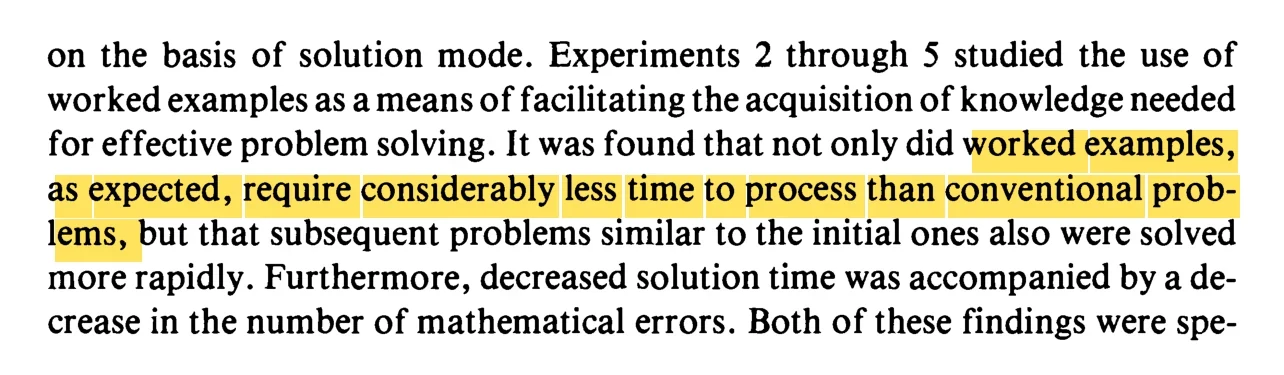
“worked examples, as expected, require considerably less time to process than conventional problems”

Worked steps, one move each
In the film, Sweller and Cooper's line is followed by the real Steps card. A worked example in DuckyHelper is short and comes when it helps:
- Worked steps, one move each (Mac and web)
- A similar example, not your homework (Mac and web)
- Worked out on the blackboard (Mac and web)
- The worked step is a rung, not the start (Mac app)
What the research found
John Sweller and Graham Cooper had algebra students either solve problems or study worked examples of the same problems. The examples took considerably less time to work through, and the students who studied them then solved similar problems faster and with fewer mistakes:
subsequent problems similar to the initial ones also were solved more rapidly
(Sweller & Cooper, 1985)
Sweller's cognitive load theory explains why: searching for a solution uses up the working memory a beginner needs to learn the pattern behind it.
conventional problem‐solving activity is not effective in schema acquisition
(Sweller, 1988)
How to use examples well
Reviews of the research give practical rules. Examples work best right next to practice problems of the same kind:
examples should be presented in close proximity to matched practice problems
(Atkinson et al., 2000)
Learning from examples is a very effective means of initial cognitive skill acquisition
(Renkl, 2014)
The same U.S. Department of Education guide that recommends spacing also recommends alternating worked examples with problems to solve (Pashler et al., 2007). The key word in Renkl's sentence is initial. As learners get better, full examples stop helping and can even get in the way (the expertise reversal effect, Kalyuga et al., 2003), so the steps should fade into practice.
Feature by feature

Worked steps, one move each
Ask "solve this step by step": 3 to 6 steps, each a single move, explained in a sentence (what changes and why) with the math beside it. In the Mac app, Keep turns them into a note you can drag anywhere. In Eddy, they open as a Worked out window. Mac and web.
A similar example, not your homework
On homework, the steps show only how far you got plus a hint for the next one. When you are stuck, the tutor works a similar problem with you, then hands yours back. Mac and web.
Worked out on the blackboard
On Eddy's blackboard, math is written one step per beat, the part that changes circled and the rule noted beside it, then a question for you. Mac and web.
The worked step is a rung, not the start
In the Mac app's hint ladder, the worked step comes after a nudge and a bigger hint, so the example arrives when you need it. Mac app.
What this page does not claim
These studies tested other people, other schools and other tools. DuckyHelper has not been tested in a study like these, so none of these results are DuckyHelper's results. They are the reasons behind how it teaches.
The papers on this page
Frequently asked questions
What is the worked example effect?
Beginners learn more from studying problems that are already solved, step by step, than from solving the same problems on their own. Sweller and Cooper (1985) showed it with algebra; many later studies found the same.
Do worked examples always help?
No. They help most at the start. As a learner gets better, full examples can stop helping (the expertise reversal effect), so good teaching fades them into practice.
Will DuckyHelper do my homework step by step?
It will show you how with a similar example, and show your steps so far with a hint for what comes next. It is built not to hand over the full solution to graded work.
Sources
- Sweller, J., & Cooper, G. A. (1985). The Use of Worked Examples as a Substitute for Problem Solving in Learning Algebra. Cognition and Instruction, 2(1), 59-89. (accessed 2026-10-09)
- Sweller, J. (1988). Cognitive Load During Problem Solving: Effects on Learning. Cognitive Science, 12(2), 257-285. (accessed 2026-10-09)
- Atkinson, R. K., Derry, S. J., Renkl, A., & Wortham, D. (2000). Learning from Examples: Instructional Principles from the Worked Examples Research. Review of Educational Research, 70(2), 181-214. (accessed 2026-10-09)
- Renkl, A. (2014). Toward an Instructionally Oriented Theory of Example-Based Learning. Cognitive Science, 38(1), 1-37. (accessed 2026-10-09)
- Kalyuga, S., Ayres, P., Chandler, P., & Sweller, J. (2003). The Expertise Reversal Effect. Educational Psychologist, 38(1), 23-31. (accessed 2026-10-09)
- Kirschner, P. A., Sweller, J., & Clark, R. E. (2006). Why Minimal Guidance During Instruction Does Not Work: An Analysis of the Failure of Constructivist, Discovery, Problem-Based, Experiential, and Inquiry-Based Teaching. Educational Psychologist, 41(2), 75-86. (accessed 2026-10-09)
- Pashler, H., Bain, P. M., Bottge, B. A., Graesser, A., Koedinger, K., McDaniel, M., & Metcalfe, J. (2007). Organizing Instruction and Study to Improve Student Learning. IES Practice Guide (NCER 2007-2004), U.S. Department of Education. (accessed 2026-10-09)
- Gick, M. L., & Holyoak, K. J. (1980). Analogical problem solving. Cognitive Psychology, 12(3), 306-355. (accessed 2026-10-09)
- Gentner, D., Loewenstein, J., & Thompson, L. (2003). Learning and transfer: A general role for analogical encoding. Journal of Educational Psychology, 95(2), 393-408. (accessed 2026-10-09)
Related principles

Ready to learn
DuckyHelper is ready on your Mac. Learn with Eddy on its blackboard, or with Ducky right on your screen.