
Draw it as you explain
People learn more from words and pictures together than from words alone, because they connect the two in their heads (Mayer and Moreno, 2003; Clark and Paivio, 1991). Watching a diagram being drawn while it is explained helped beginners more than seeing it already drawn (Fiorella and Mayer, 2016). DuckyHelper draws while it talks: on your real screen with Ducky, and on Eddy's blackboard in the Eddy tab.
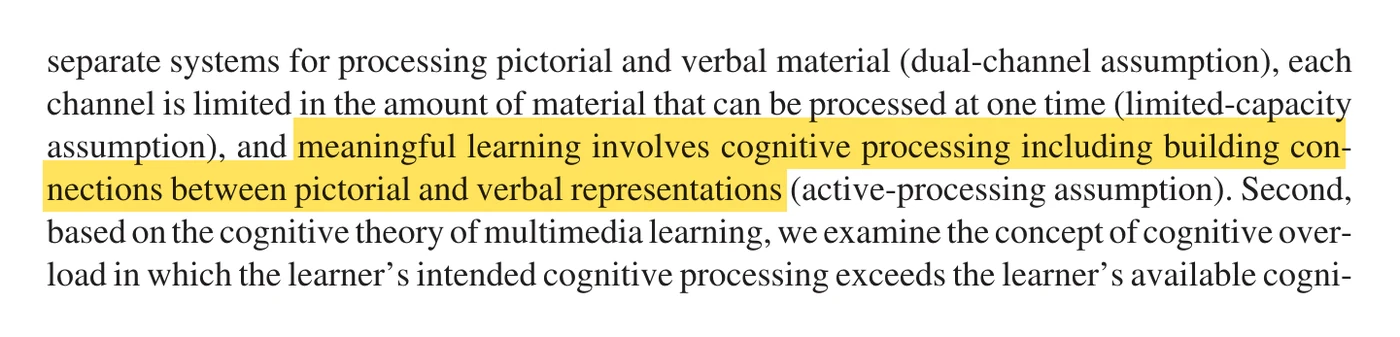
“meaningful learning involves cognitive processing including building connections between pictorial and verbal representations”

It draws while it talks
In the film, Ducky's real pen underlines Mayer and Moreno's line, then draws a pendulum. Pictures and words arrive together:
- It draws on your real screen (Mac app)
- It points while it talks (Mac app)
- Words and drawing in time (Mac and web)
- Labels on the picture (Mac and web)
- You can point too (Mac app)
What the research found
Richard Mayer and Roxana Moreno summed up years of multimedia research in one idea: understanding comes from linking what you see with what you hear.
Their paper lists nine ways to keep either channel from being overloaded, such as narrating a picture instead of covering it with text, and putting words next to the part they describe. Dual coding theory (Clark and Paivio, 1991) gives the older reason: memory has a verbal code and an imagery code, and teaching can use both.
Drawing beats a finished picture
In five experiments, Logan Fiorella and Richard Mayer compared a video lesson with already-drawn diagrams against the same lesson where the instructor drew the diagrams by hand:
watching the instructor draw diagrams (by viewing the instructor's full body) resulted in significantly better transfer test performance than viewing already-drawn diagrams for learners with low prior knowledge
(Fiorella & Mayer, 2016)
Pointing and gesture help in a similar way. Children asked to gesture while learning a new math idea kept what they learned better (Cook, Mitchell and Goldin-Meadow, 2008), and a diagram can make a problem easier simply because related things sit in one place (Larkin and Simon, 1987).
Feature by feature

It draws on your real screen
In the Mac app, Ducky circles, underlines, boxes and labels things on your own page, one mark at a time like a pen, in any app. The marks stay on what they were drawn on when you scroll. Mac app.
It points while it talks
When it says "this", a round blue pointer flies to the spot and labels it. Mac app.
Words and drawing in time
On Eddy's blackboard, you hear each sentence just as its drawing appears, so what you hear and what you see line up. The picture grows piece by piece instead of being redrawn. Mac and web.
Labels on the picture
Ask Eddy to show you inside a leaf: a picture comes into focus and labels are drawn on it one by one as Eddy names the parts. Click a part to ask about it. Mac and web.
You can point too
In the Mac app, hold fn + cmd and move the mouse over something: a blue trail follows, and Ducky gets a picture with your path on it, so "what is this?" just works. Mac app.
What this page does not claim
These studies tested other people, other schools and other tools. DuckyHelper has not been tested in a study like these, so none of these results are DuckyHelper's results. They are the reasons behind how it teaches.
The papers on this page
Frequently asked questions
What is multimedia learning?
The finding that people learn more deeply from words and pictures together than from words alone, as long as neither channel is overloaded. Richard Mayer's research is the best known; Mayer and Moreno (2003) list nine ways to reduce overload.
Why is watching someone draw better than a finished diagram?
In Fiorella and Mayer (2016), learners with little prior knowledge did better on transfer tests after watching the instructor draw diagrams than after seeing them already drawn. Drawing shows the parts in the order they are explained.
Can DuckyHelper draw on my screen on a Chromebook?
No. DuckyHelper is a Mac app (macOS 14 or later, Apple silicon), with no Chromebook or web version right now. In it, Ducky draws on your real screen, and Eddy draws on its own blackboard and on pictures.
Sources
- Mayer, R. E., & Moreno, R. (2003). Nine Ways to Reduce Cognitive Load in Multimedia Learning. Educational Psychologist, 38(1), 43-52. (accessed 2026-10-09)
- Clark, J. M., & Paivio, A. (1991). Dual coding theory and education. Educational Psychology Review, 3(3), 149-210. (accessed 2026-10-09)
- Fiorella, L., & Mayer, R. E. (2016). Effects of observing the instructor draw diagrams on learning from multimedia messages. Journal of Educational Psychology, 108(4), 528-546. (accessed 2026-10-09)
- Cook, S. W., Mitchell, Z., & Goldin-Meadow, S. (2008). Gesturing makes learning last. Cognition, 106(2), 1047-1058. (accessed 2026-10-09)
- Goldin-Meadow, S., Cook, S. W., & Mitchell, Z. A. (2009). Gesturing Gives Children New Ideas About Math. Psychological Science, 20(3), 267-272. (accessed 2026-10-09)
- Larkin, J. H., & Simon, H. A. (1987). Why a Diagram is (Sometimes) Worth Ten Thousand Words. Cognitive Science, 11(1), 65-100. (accessed 2026-10-09)
- Ainsworth, S. (2006). DeFT: A conceptual framework for considering learning with multiple representations. Learning and Instruction, 16(3), 183-198. (accessed 2026-10-09)
- Tversky, B., Morrison, J. B., & Betrancourt, M. (2002). Animation: can it facilitate? International Journal of Human-Computer Studies, 57(4), 247-262. (accessed 2026-10-09)
- Wammes, J. D., Meade, M. E., & Fernandes, M. A. (2016). The drawing effect: Evidence for reliable and robust memory benefits in free recall. Quarterly Journal of Experimental Psychology, 69(9), 1752-1776. (accessed 2026-10-09)
- Bobek, E., & Tversky, B. (2016). Creating visual explanations improves learning. Cognitive Research: Principles and Implications, 1(1), 27. (accessed 2026-10-09)
Related principles

Ready to learn
DuckyHelper is ready on your Mac. Learn with Eddy on its blackboard, or with Ducky right on your screen.