
A model built to teach
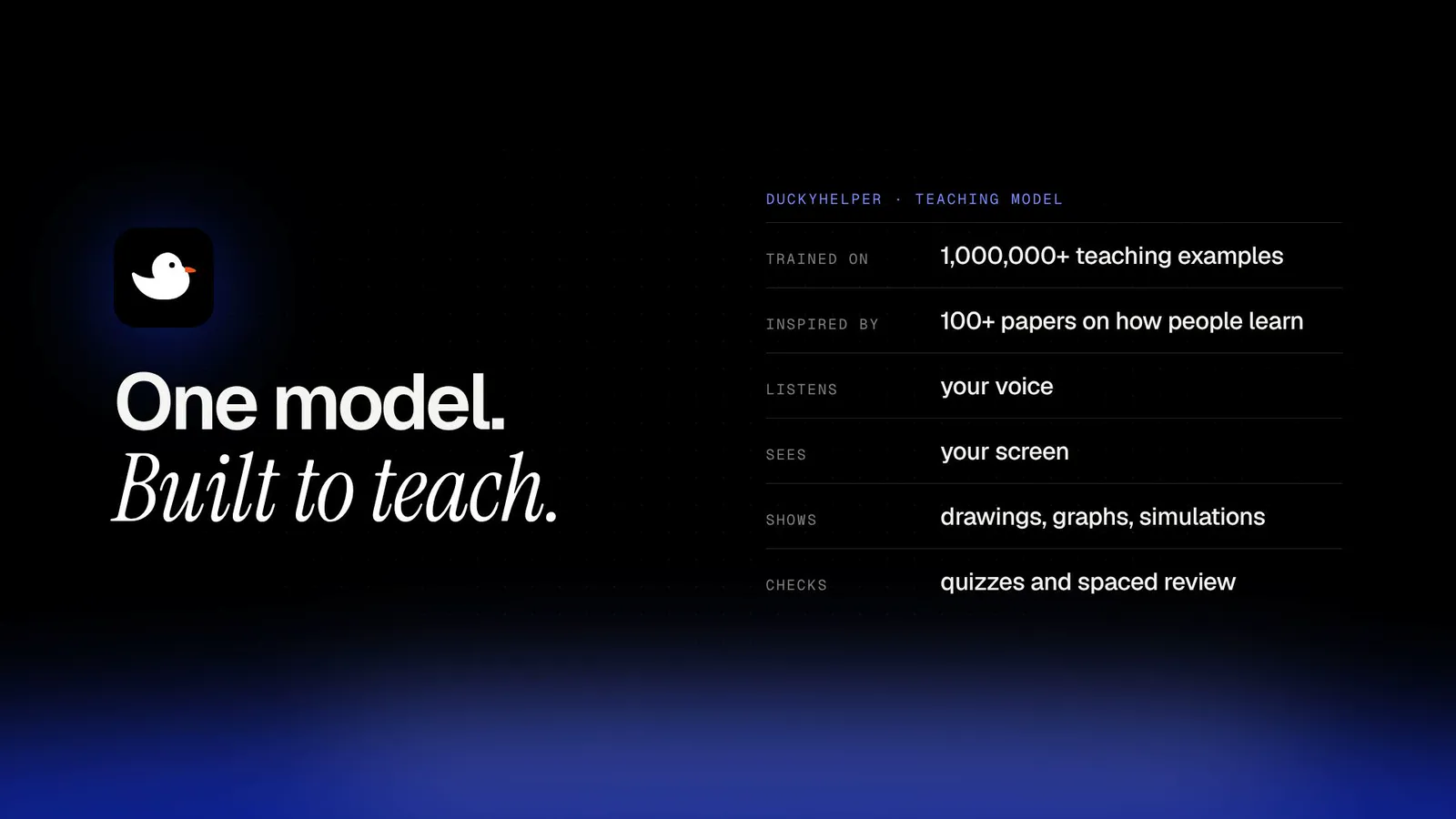
DuckyHelper's tutor is built to teach and trained to teach. It is trained on 1,000,000+ tutoring examples and inspired by 100+ learning-science papers. It is a tutor, not an answer machine: it asks what you think, gives hints before answers, draws while it explains, checks you with quick questions and brings ideas back on a spaced schedule.

Answers are easy. Learning is not.
A chatbot is built to answer. That is great for facts and bad for homework: in a 2025 field experiment, students who practiced with a plain GPT-4 chat did worse on the exam once it was gone, while a version built to hint instead of answer mostly avoided the harm. Getting the answer and learning how are different jobs. DuckyHelper does the second one. What that study found
The model card
| What | DuckyHelper's tutor |
|---|---|
| Built to | Teach. A tutor, not an answer machine |
| Trained on | 1,000,000+ tutoring examples |
| Inspired by | 100+ learning-science papers (see the library) |
| Listens to | Your voice, in your language |
| Looks at | Your screen, in the Mac app only, while you talk to it |
| Shows with | Drawings on your screen, a blackboard, pictures, graphs, simulations, worked steps |
| Checks with | Questions, quizzes, hints and spaced flashcard review |
Trained on 1,000,000+ tutoring examples
Trained to teach, on a million examples of tutoring, and built around 100+ papers on how people learn. The film shows it as one real exchange pulling back to a million.
Seven principles, in the film's order
| Principle | Paper in the film | What the tutor does | Film | |
|---|---|---|---|---|
| 01 | Teach one on one | Bloom, 1984 | A live voice tutor for one learner | 23.4 s |
| 02 | Guide, don't hand over answers | Bastani et al., 2025 | Hints before answers | 31.0 s |
| 03 | Draw it as you explain | Mayer & Moreno, 2003 | The pen draws on your screen | 34.8 s |
| 04 | Show a worked example | Sweller & Cooper, 1985 | Worked steps, one move each | 38.6 s |
| 05 | Quiz, don't re-read | Roediger & Karpicke, 2006 | Quizzes in the moment | 42.4 s |
| 06 | Have them explain it back | Chi et al., 1994a | Asks what you think | 46.2 s |
| 07 | Space it out | Cepeda et al., 2006 | Flashcards that come back | 50.0 s |
How it teaches, in one session
- 1. You ask
You ask out loud, about anything, or about what is on your screen (the Mac app sees it).
- 2. It asks what you think
It asks what you already think, then explains in short steps, drawing as it talks.
- 3. One question per step
After each step it asks one question and waits for your answer.
- 4. Hints, then the answer
Stuck? A nudge, a bigger hint, the worked step. The answer comes last.
- 5. It points at the slip
Got it wrong? It points at the exact step, and says why.
- 6. It comes back later
What you missed becomes a flashcard that comes back before you forget it.
Honest limits
DuckyHelper has not been tested in a controlled study, and we publish no benchmark scores or learning gains of our own. The numbers on these pages belong to the papers that reported them. When we run a study, its results will be here, whatever they show.
More films
Frequently asked questions
What is DuckyHelper trained on?
DuckyHelper's tutor is trained on 1,000,000+ tutoring examples and inspired by 100+ learning-science papers. It is trained to teach: to guide, hint and check rather than hand over answers.
What does built to teach mean?
That every part of the tutor is designed around how people learn: it asks before it tells, hints before it answers, draws while it explains, checks with quick questions and schedules review. The principles page links each behaviour to its research.
Is DuckyHelper just ChatGPT?
No. A general chatbot is built to answer questions. DuckyHelper's tutor is trained on tutoring examples and has teaching rules and tools (hints, quizzes, flashcards, drawing on your screen) that a chatbot does not.
Has DuckyHelper been studied?
Not yet. It has no study results of its own. We cite the published research it is built on, and when a study of DuckyHelper is done, its results will be published here.
Sources
- Bloom, B. S. (1984). The 2 Sigma Problem: The Search for Methods of Group Instruction as Effective as One-to-One Tutoring. Educational Researcher, 13(6), 4-16. (accessed 2026-10-09)
- Bastani, H., Bastani, O., Sungu, A., Ge, H., Kabakcı, Ö., & Mariman, R. (2025). Generative AI without guardrails can harm learning: Evidence from high school mathematics. Proceedings of the National Academy of Sciences, 122(26), e2422633122. (accessed 2026-10-09)
- Mayer, R. E., & Moreno, R. (2003). Nine Ways to Reduce Cognitive Load in Multimedia Learning. Educational Psychologist, 38(1), 43-52. (accessed 2026-10-09)
- Sweller, J., & Cooper, G. A. (1985). The Use of Worked Examples as a Substitute for Problem Solving in Learning Algebra. Cognition and Instruction, 2(1), 59-89. (accessed 2026-10-09)
- Roediger, H. L., & Karpicke, J. D. (2006). Test-Enhanced Learning: Taking Memory Tests Improves Long-Term Retention. Psychological Science, 17(3), 249-255. (accessed 2026-10-09)
- Chi, M. T. H., De Leeuw, N., Chiu, M.-H., & Lavancher, C. (1994a). Eliciting Self-Explanations Improves Understanding. Cognitive Science, 18(3), 439-477. (accessed 2026-10-09)
- Cepeda, N. J., Pashler, H., Vul, E., Wixted, J. T., & Rohrer, D. (2006). Distributed practice in verbal recall tasks: A review and quantitative synthesis. Psychological Bulletin, 132(3), 354-380. (accessed 2026-10-09)

Ready to learn
DuckyHelper is ready on your Mac. Learn with Eddy on its blackboard, or with Ducky right on your screen.