
An AI chemistry tutor for every reaction
DuckyHelper is an AI chemistry tutor that shows you what the atoms are doing. Ask what a chemical bond is and Eddy draws two atoms sharing a pair of electrons and labels each part. Ask why ice floats and it walks through the molecules, with real numbers. Then it works your equations step by step, gives hints before answers, and quizzes you. It is a Mac app, and Ducky helps on your own worksheet too.
Chemistry you can see
Atoms are too small to see, so a good chemistry answer is a picture with the right labels. Two questions from our films:
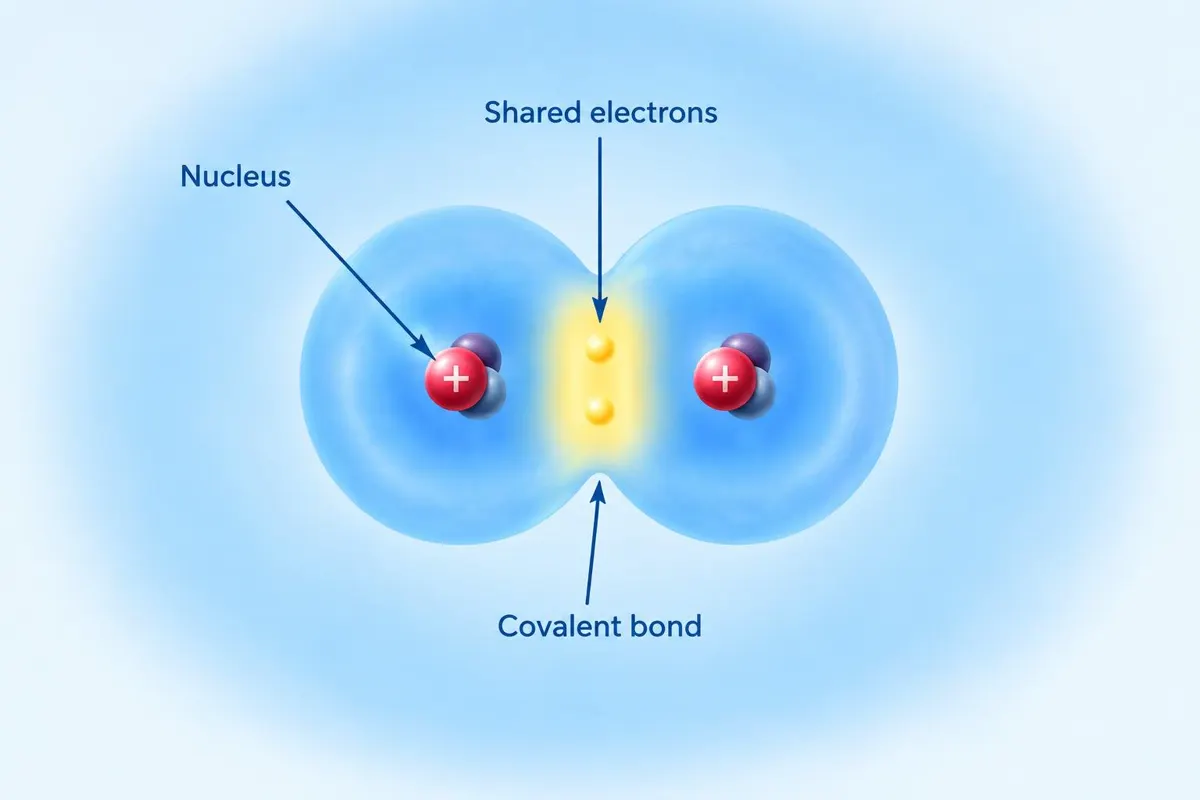
What is a chemical bond?
This is the picture Eddy made for the question: two hydrogen atoms, each nucleus marked, and the pair of electrons they share between them, labelled as a covalent bond. Ask what happens if you pull the atoms apart, and Eddy explains it out loud.

Why does ice float?
The real Eddy bar hears the question, then the answer is told in dots: in water the molecules pack in tight, and in ice each one holds its neighbors at arm's length, so the same molecules take up more room. Less dense means it floats.
What does the film say about bonds?
The type film carries the same question through every frame, and keeps it true: a pair of electrons, a covalent bond shares 2 electrons, and the date 04-1916, when G. N. Lewis proposed the shared pair. Then H2 and CO2, molecules held together by bonds.
Why ice floats, in four numbers
| What | Number | Why it matters |
|---|---|---|
| Liquid water at 4 °C | 1.000 grams per cubic centimeter | Water is densest at about 4 °C, so the coldest water near freezing rises and lakes freeze from the top down. |
| Ice | about 9 percent less dense than water | Freezing locks each molecule to its neighbors in an open lattice, so the same mass takes up more room. |
| Most solids | denser than their own liquid | Water is the odd one out: if ice sank, lakes would freeze from the bottom up. |
| An iceberg | almost all of it below the waterline | Ice is only a little lighter than water, so only a small part of it rides above the surface. |
Numbers from the USGS Water Science School page on water density (checked 2026-10-09). This is the kind of worked answer Eddy builds when you ask it to look something up: real sources, quoted, with numbered citations.

Stoichiometry, one move at a time
Paste or say the problem, or open your worksheet with Open a file. Ask for it step by step and you get 3 to 6 steps, one move each: convert to moles, use the ratio from the balanced equation, convert back. Ask why any step works and Eddy explains that move.
In Eddy's homework mode you get a hint first and do the move yourself. In the Mac app, Hint opens a ladder: a nudge, a bigger hint, the worked step, and the answer last.
Ask for a graph of a reaction rate or a gas law and it is one you can hover, pan and zoom, with sliders for the letters. Some questions open a small simulation you can play with and read the numbers from.
Ask for flashcards of symbols, ions or polyatomic names. The ones you miss come back right before you would forget them.
Chemistry study guides
Ask Eddy
Say one of these out loud. Eddy picks how to show it: words, a picture or the board.

How to use it
Frequently asked questions
Can an AI tutor help with chemistry homework?
Yes. Open your worksheet in Eddy or ask about the problem out loud, and it works the problem in short steps with the math written out, giving a hint before each answer. On a Mac, press fn and ask about the problem already on your screen.
Can it show me molecules and bonds?
Ask to see a bond or a molecule and Eddy opens a picture on its desk, then labels the nuclei, the shared electrons and the bond as it names them. Click any part to ask about it. Made pictures are part of Plus and up; drawn diagrams work on any plan.
Will it check my chemistry answers?
Ask it to check your work and it looks at each step, not just the final number, and tells you which step to look at again. Quizzes mark each answer and say why a wrong one is wrong.
Does it work on a school Chromebook?
Not right now: DuckyHelper is a Mac app (macOS 14 or later, Apple silicon). There is no Chromebook or web version. On a Mac, Eddy brings steps, pictures, graphs, quizzes and flashcards, and Ducky sees and draws on your screen.
Sources
- USGS Water Science School, Water density (accessed 2026-10-09)
More subjects
See what the atoms are doing
Get the Mac app, open the Eddy tab and ask your chemistry question out loud.