
An AI music theory tutor that shows the sound
DuckyHelper is an AI music theory tutor that explains the why behind what you hear. Ask why a minor chord sounds sad and Eddy puts the chord on a keyboard and labels the root and the minor third. Ask how a guitar string makes a note and you see the string vibrate, then pluck it with one button. Scales, intervals and rhythm work the same way, in the DuckyHelper Mac app.
Hear it. Then see why.
Two questions our films ask, and what Eddy put on its desk for each.
Why does a minor chord sound sad?
Eddy shows a C minor chord on a keyboard and labels it as it explains: the root, then the middle note, a half step lower than in C major. That smaller gap, three half steps instead of four, is the minor third, and it is most of what you hear as sad.

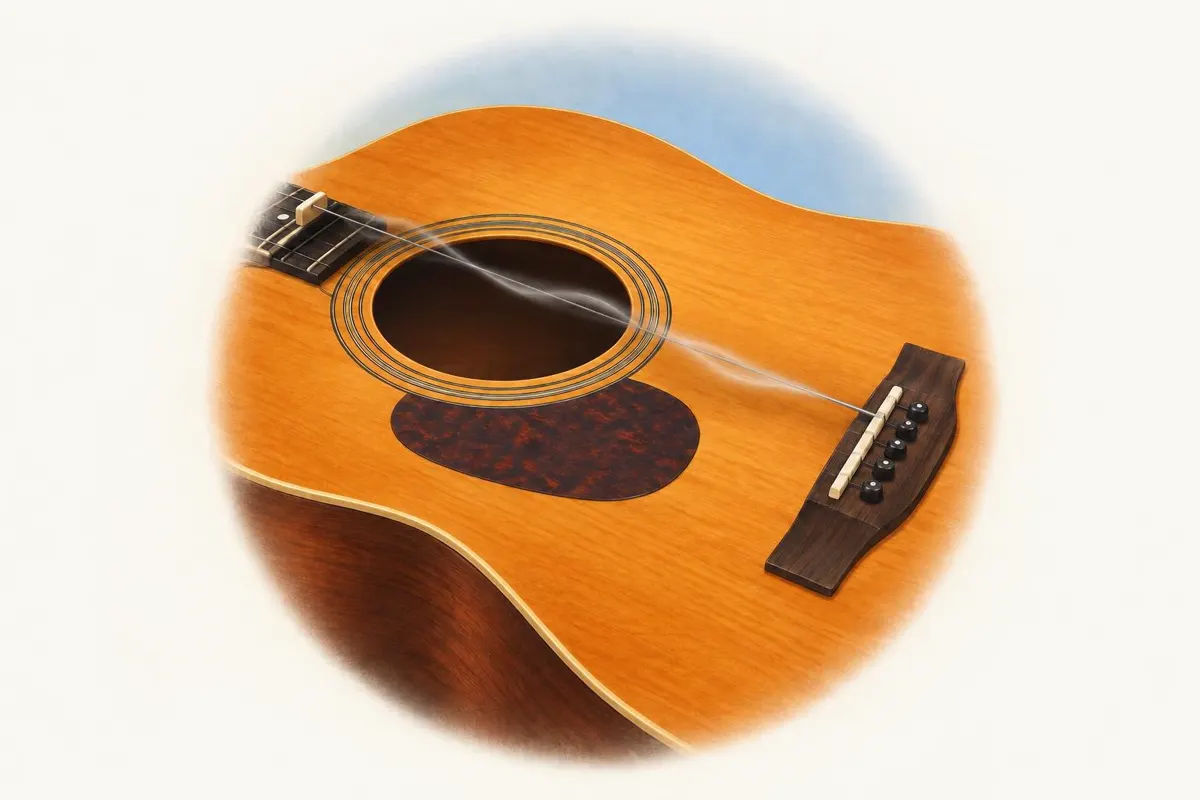
How does a guitar string make a note?
The picture shows a string between the nut and the bridge, vibrating. Pluck it and it swings back and forth many times a second; how many times sets the pitch. A shorter, tighter or thinner string swings faster and sounds higher, which is why pressing a fret raises the note.
Pluck it, slow it, zoom in
Next to the bar, up to three round buttons change the picture in front of you, and Eddy explains what changed. Hover one to see its name. Picture edits are part of Plus and up.

Edit buttons
For the guitar string they were Pluck the string, Slow the wave and Zoom into bridge. Each one changes the picture with a soft morph.

Tap a part to ask
Click any part of a picture, like the bridge or a key, and Eddy tells you about just that part.

Choose how Eddy answers
The chip at the left of the bar picks the answer: Eddy picks, Just words, Look it up, A picture or A scene.
What you can ask about

Intervals and chords
Major and minor thirds, fifths, sevenths: where each sits on a keyboard and why it sounds the way it does.

Scales and keys
Why a major scale has its pattern of whole and half steps, and how key signatures follow from it.

Rhythm in numbers
Time signatures, note lengths and syncopation, worked out as fractions of a beat you can count.

How sound works
Strings, air columns and frequency: the physics behind pitch and why an octave doubles it.
What it won't do
Listen to you play
Play the music for you
Replace a teacher for technique
Ask Eddy
Say one of these out loud. Eddy picks how to show it: words, a picture or the board.

How to use it
Frequently asked questions
Can an AI tutor teach music theory?
Yes. Ask about intervals, chords, scales or rhythm and Eddy explains out loud and shows it: a chord on a labelled keyboard, a string vibrating, rhythm counted as fractions of a beat. A quick quiz afterwards checks it stuck.
Can it hear me play an instrument?
No. The microphone is for talking to your tutor, and Eddy does not listen to or grade your playing. Use it for the theory behind what you play, and a teacher for technique.
Why does a minor chord sound sad?
A minor chord's middle note is a half step lower than in the major chord on the same root: three half steps above the root instead of four. That smaller interval, the minor third, is most of what makes it sound darker. Ask Eddy and it shows it on a keyboard.
Does it work on a Chromebook?
Not right now: DuckyHelper is a Mac app (macOS 14 or later, Apple silicon). There is no Chromebook or web version. In the Mac app, made pictures and picture edits are part of Plus and up, and Pricing shows what each plan includes.
More subjects
Ask why it sounds that way
Get the Mac app, open the Eddy tab and ask your music question out loud.